Having an ESIC e-Pehchan Card does not by itself tell you where to go, which hospital will accept you, or whether a referral is required.
For treatment, the important steps are to first identify the correct ESI dispensary or ESIC hospital, make sure the patient is properly included in your ESIC family record, and carry the documents needed for consultation.
For most routine medical care, treatment begins through the ESI dispensary or ESIC healthcare facility linked to your insured-person record. From there, you may be examined, treated directly, or referred to a higher ESIC hospital or another approved facility when specialist care is needed.
This distinction is especially important for private hospitals.
An ESIC card does not automatically provide cashless treatment at any private hospital of your choice. Private or empanelled hospital treatment generally depends on the ESIC referral and authorisation process, except where emergency rules or another applicable arrangement allows treatment differently.
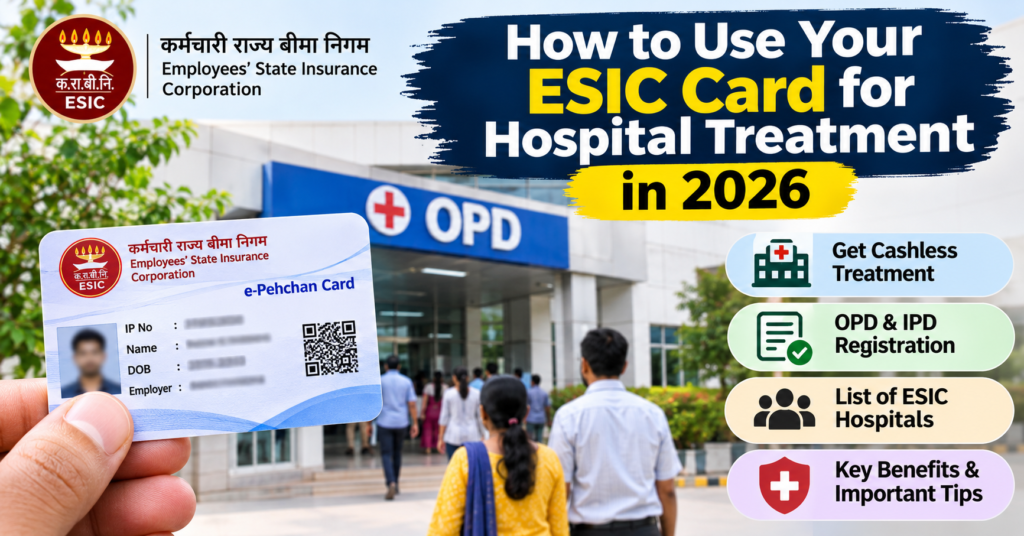
This guide explains how to use your ESIC card at a hospital, where to go first, what documents to carry, how family members can receive treatment, when a referral is needed, and how treatment at an ESIC-empanelled private hospital works.
On this page15 sections · jump to what you need
Who Can Use an ESIC Card for Medical Treatment?
ESIC medical treatment is available to the insured person and eligible family members, subject to the applicable ESI medical-benefit rules.
Medical benefit starts from the first day of entering insurable employment, so an insured worker does not have to complete a long waiting period before becoming eligible for basic medical care. ESIC’s current medical-benefit material continues to state that coverage for the insured worker and eligible family members begins from the first day of employment.
However, the e-Pehchan Card is primarily an identification and entitlement document. It should not be treated as automatic approval for every specialist treatment, procedure, referral or private-hospital admission.
For a family member to use ESIC medical services smoothly, their details should be correctly recorded in the insured person’s ESIC family record.
Before travelling to an ESI dispensary or hospital, check that:
- the family member’s name is present
- the relationship is recorded correctly
- date of birth and other identifying details are accurate
- any recent family addition or correction has been processed
- the person’s medical entitlement can be verified in the ESIC record
If a spouse, child, parent or another eligible family member is missing from the record, downloading the same e-Pehchan Card again will not add them.
The family details need to be corrected or updated first.
Can Family Members Use the ESIC Card in Another City?
The Pehchan/e-Pehchan system is intended to identify the insured person and eligible family members for ESI medical care, including when treatment is needed away from the usual place of residence, subject to entitlement and the applicable ESIC/ESIS facility arrangement.
For planned treatment, however, it is still sensible to confirm the correct dispensary, hospital or referral route before travelling.
ESIC Family Coverage Changed From November 2025
Be careful with old ESIC articles that use pre-2025 family definitions.
The Code on Social Security, 2020 came into force on 21 November 2025, and ESIC subsequently instructed its offices to apply the revised definitions of “family” and “dependant.”
One important change affects women employees.
Under the revised definition, the following are now included within the family definition for medical benefit:
- father-in-law of a woman employee
- mother-in-law of a woman employee
This is a significant change because older ESIC material may still state that these relatives are excluded.
Eligibility can still depend on the applicable statutory conditions and the person being correctly recorded in the ESIC system, so inclusion in the legal definition should not be confused with automatic approval without verification.
Why Older ESIC Family Lists Can Be Misleading
Some older ESIC manuals specifically excluded a woman employee’s father-in-law and mother-in-law from the family definition. That guidance predates the 2025 implementation change and should not be used by itself for a 2026 treatment decision.
For 2026, use the current ESIC family record and updated rules rather than relying only on an old list copied from a previous version of the ESI Act guidance.
If eligibility is unclear—for example, because of dependency conditions, age, marital status, or a recently added family member—confirm the record with ESIC before a planned hospital visit.
ESIC Card Holder, Family Member and Treatment Approval Are Not the Same Thing
It helps to separate three different questions:
Is the person covered under ESIC?
This depends on whether they qualify as the insured person or an eligible family member.
Is the person correctly recorded in the ESIC system?
Their details should appear correctly in the insured person’s family record.
Is a particular treatment authorised?
Specialist care, referral treatment or empanelled private-hospital treatment may require a separate referral or approval process.
So, having a name on the e-Pehchan Card does not automatically mean that every hospital or every treatment can be accessed directly without following the ESIC treatment pathway.
What Medical Services Does ESI Cover?
ESI medical care can include outpatient consultation, medicines, diagnostic services, specialist treatment and hospitalisation, depending on the patient’s medical need and the applicable ESIC/ESIS treatment arrangement.
The important point is that the same e-Pehchan Card may be used for identification, but the treatment process is not identical for every type of care.
| Medical Need | Where to Start / What to Check |
|---|---|
| Routine OPD consultation | Assigned ESI dispensary, ESIC hospital or appropriate ESI medical facility |
| Regular medicines or follow-up | Continue through the facility or department managing the patient’s treatment |
| Blood tests, scans or other investigations | Follow the doctor’s prescription and the facility’s test instructions |
| Specialist consultation | Check whether the specialty is available directly or requires referral |
| Planned admission or procedure | Confirm the hospital, referral and any required authorisation before admission |
| Super-speciality treatment | Follow the ESIC referral and approval pathway applicable to the case |
| Medical emergency | Obtain urgent medical care first; complete ESIC verification and documentation as soon as reasonably possible |
So, for example, an insured person visiting an ESI dispensary for a routine fever consultation does not follow the same process as someone being sent for a planned cardiac procedure at an empanelled hospital.
Routine OPD Treatment
For common illnesses, follow-up consultations and continuing prescriptions, the usual starting point is the ESI dispensary or ESI healthcare facility responsible for the patient’s care.
Carry the e-Pehchan Card and relevant medical records so the facility can verify the patient and continue treatment.
Depending on the case, the doctor may:
- prescribe medicines
- advise tests
- schedule a follow-up
- refer the patient to a specialist
- send the patient to a higher ESI facility
A referral should be followed according to the instructions given rather than independently selecting another hospital.
Tests and Diagnostic Services
If an ESI doctor recommends a blood test, imaging study or another investigation, follow the instructions written on the prescription or referral.
The test may be:
- available at the same ESI facility
- provided at another ESI hospital
- arranged through an authorised diagnostic facility
Do not assume that every test can be obtained at any laboratory simply by showing the ESIC card.
Specialist and Hospital Treatment
Specialist consultation may be available directly at an ESIC or ESIS hospital, or the patient may first need to be referred from the dispensary or treating facility.
For a planned admission, procedure or super-speciality treatment, confirm:
- which hospital has been authorised
- whether a referral has been issued
- whether any approval is still pending
- what documents must be carried
- whether the patient needs to report to a particular department or counter
This becomes especially important when treatment is being arranged outside the normal ESI facility network.
Emergency Treatment
A medical emergency should not be delayed merely because the patient does not have every ESIC document ready at that moment.
If the situation is genuinely urgent, obtain necessary medical care and complete the applicable ESIC verification, referral or reimbursement formalities as soon as practicable.
Keep:
- emergency records
- prescriptions
- investigation reports
- admission papers
- bills and receipts, where applicable
- discharge summary
These documents may be important later if ESIC verification or another claim process is required.
Medical Treatment and ESIC Cash Benefits Are Different
ESIC medical benefit and ESIC cash benefits are separate parts of the scheme.
Getting treatment at an ESI dispensary or hospital does not automatically start a claim for money.
Cash benefits such as:
- sickness benefit
- maternity benefit
- temporary disablement benefit
- permanent disablement benefit
can have their own contribution conditions, medical certification and claim procedures.
So a person may be eligible for treatment but still need to complete a separate process before receiving a cash payment.
Likewise, an OPD prescription or hospital visit by itself should not be treated as proof that a cash-benefit claim has been approved.
General ESIC Medical Eligibility Does Not Mean Every Treatment Is Automatically Approved
It is also important to separate medical entitlement from treatment authorisation.
An insured person may be entitled to ESI medical care, but that does not mean they can directly choose:
- any private hospital
- any super-speciality procedure
- any diagnostic centre
- any planned admission
and expect ESIC to pay automatically.
The correct route depends on the treatment required, the available ESI facility, and whether a referral or authorisation is needed.
For planned specialist or private-hospital treatment, confirm the treatment pathway before admission whenever possible.
Where Should You Go for Your First ESIC Treatment Visit?
For a routine medical problem, start with the ESI dispensary, ESIC hospital or ESIS medical facility linked to your treatment arrangement, where applicable.
If you are not sure which facility to use, check the Health Services section on the official ESIC website or ask ESIC or your employer’s HR team to help identify the appropriate starting point.
This is particularly important if:
- you recently changed jobs
- you moved to another city
- your family member lives elsewhere
- you need a specialty that is not available at your usual dispensary
- you have never used ESI medical services before
Before travelling, confirm:
- whether the facility handles the treatment you need
- OPD registration timings
- department availability
- whether advance booking is supported
- whether a referral is required
- what documents the patient should carry
Do not assume that every ESIC or state-run ESI facility provides exactly the same departments or registration process.
ESIC Hospital vs State ESI Hospital
You may see both ESIC-run hospitals and hospitals or dispensaries operated through a state ESI medical-services system.
Both can form part of ESI medical care, but the administration and local treatment pathway can differ.
For the patient, the practical question is not who operates the building. It is:
Is this the correct facility for my record and the treatment I need?
Confirm that before making a long journey.
If Your Family Member Lives in Another City
If your spouse, child, parent or another eligible family member lives separately, tell ESIC the actual situation.
Ask:
- where that family member should receive routine treatment
- whether residence details need updating
- whether the allotted dispensary or medical facility needs changing
- what documents are needed for treatment in the other city
Do not enter a false address simply to obtain a more convenient hospital allocation.
Correcting the record properly is safer than creating a mismatch that causes problems later during treatment or verification.
What to Carry to an ESI Dispensary or Hospital
You usually need more than just the e-Pehchan Card.
Keep the patient’s identification and relevant medical records together before leaving home.
| What to Carry | Why It May Be Needed |
|---|---|
| Latest e-Pehchan Card | Identifies the insured-person and ESIC record |
| Government-issued photo ID | Supports patient identity verification where required |
| Appointment confirmation | Helps locate an online or app-based booking |
| Previous prescriptions | Shows earlier diagnosis, medicines and treatment |
| Test and investigation reports | Helps the doctor avoid unnecessary repetition and review earlier findings |
| Referral letter | Shows where and why the patient has been referred |
| Treatment authorisation, if applicable | Confirms approval for the next stage of planned treatment |
| Update acknowledgement | Helps explain a recent family or record correction that may still be processing |
A pending-update receipt can explain why the details differ, but it does not automatically prove that the change has been approved or that treatment entitlement has been established.
If you have not saved the latest card, use the ESIC Card Download Guide before travelling.
Keep a readable copy available offline as well. A hospital visit should not depend entirely on having mobile data at the registration counter.
How to Use Your ESIC Card for a Routine Consultation
For ordinary OPD treatment, the process is usually straightforward once you know the correct facility.
Step 1: Confirm where you should go.
Identify the appropriate ESI dispensary, hospital or medical facility and check its OPD arrangements.
Step 2: Check the patient record.
Make sure the e-Pehchan Card and ESIC family details correspond to the person who will actually receive treatment.
If a family member is attending, check their entry before travelling.
Step 3: Book an appointment if the facility supports it.
Some ESI facilities provide appointment booking through ESIC Health Connect or another local arrangement.
Save the booking reference.
Step 4: Complete hospital registration or check-in.
Present the required documents and explain whether the patient is attending for:
- a first consultation
- follow-up
- investigation
- referral
- ongoing treatment
Step 5: Attend the consultation.
Show previous prescriptions and test reports when relevant.
The doctor may prescribe medicines, request tests, arrange follow-up or issue a referral.
Step 6: Clarify the next step before leaving.
Ask:
- where prescribed medicines should be collected
- where ordered tests will be performed
- whether another appointment is needed
- whether a referral has been issued
- whether any separate authorisation is required
Keep the new prescription, reports and referral papers together.
This becomes particularly important if the treatment later moves from a dispensary to an ESIC hospital or an empanelled external facility.
Can You Book an ESIC Appointment Through Health Connect?
Yes, ESIC Health Connect supports appointment booking at participating facilities.
The 2026 Health Connect process allows the user to choose the patient, facility, date and available appointment slot and then generates a booking reference.
But booking and check-in are not the same step.
On the appointment day, Health Connect may allow the patient to generate a Check-In number.
If self check-in is completed successfully, the patient can proceed according to the app instructions.
If a Check-In number is not generated through the app, the patient may need to complete OPD registration or check-in at the hospital or dispensary counter. ESIC’s current app instructions specifically distinguish the appointment booking from this day-of-visit check-in process.
So do not assume:
appointment booked = all hospital registration completed
Follow the instructions shown for your facility and appointment.
For help accessing employee-side ESIC services, see the ESIC Insured Person Login Guide.
Can You Use an ESIC Card at a Private Hospital?
Not simply by showing the card.
An ESIC e-Pehchan Card is not a universal cashless private-hospital card.
For planned treatment at a private hospital, several things may need to be established first:
- the hospital is currently empanelled for the required service
- the patient is eligible for the treatment
- the appropriate ESI doctor or authority has issued the referral
- any required authorisation has been completed
- the proposed procedure or investigation is actually covered by that referral
A private hospital may be empanelled for some services without being authorised for every specialty or procedure.
Likewise, the fact that a hospital says “ESIC accepted” does not by itself mean your planned admission has been approved.
How ESIC Referral and Authorisation Work
If an ESI doctor refers you to another hospital, keep the written referral and read it carefully.
Check:
- patient name
- destination hospital
- specialty or department
- treatment, investigation or consultation requested
- issue date
- any validity or appointment conditions
Empanelled hospitals are expected to provide cashless treatment within the scope of a valid referral, but treatment outside what has been referred may require additional permission. ESIC empanelment conditions also make clear that direct arrival at a tie-up hospital without the normal referral process does not ordinarily create cashless eligibility.
So before a planned private-hospital visit, confirm:
referral issued → hospital correct → service covered → authorisation complete
Do not rely only on a verbal statement such as:
“ESIC works here.”
What If No ESI Facility Is Available Within 10 km?
There is an important exception for areas where ESI medical infrastructure is not available nearby.
Where an eligible beneficiary has no ESI hospital, dispensary or Insured Medical Practitioner within a 10 km radius, ESIC has allowed direct OPD consultation at certain ESIC-empanelled or Ayushman Bharat-empanelled hospitals without first obtaining a referral from an ESI dispensary or hospital.
But this should not be misunderstood as:
“If I live far away, I can use any private hospital.”
That is not the rule.
The arrangement applies to eligible patients in areas lacking nearby ESI infrastructure and to hospitals covered by the applicable empanelment arrangement.
What About Tests or Hospital Admission Under the 10 km Arrangement?
Direct OPD consultation and further treatment are not necessarily handled in the same way.
If the doctor recommends inpatient admission, the empanelled hospital must obtain the required permission from the ESI approving authority through the applicable process.
So before planned care under this exception, confirm:
- whether your residence falls within the applicable no-ESI-infrastructure area
- whether the hospital is covered by the arrangement
- whether the required service is included
- whether further permission is needed for admission or investigations
This is an exception designed to solve lack of nearby ESI infrastructure, not a general private-hospital choice facility.
Emergency Treatment: Do Not Delay Care for the Card
A genuine medical emergency should be treated as an emergency first.
Do not delay urgent treatment because:
- the e-Pehchan Card is not downloaded
- the patient cannot access Health Connect
- an online appointment has not been booked
- routine referral paperwork is incomplete
Obtain necessary emergency care.
Then, as soon as reasonably possible, contact the treating hospital and the appropriate ESI authority to clarify identification, authorisation or reimbursement requirements.
Keep every relevant document, including:
- emergency assessment
- prescriptions
- investigation reports
- admission papers
- discharge summary
- itemised hospital bills
- payment receipts
- referral or authorisation documents obtained later
This paperwork can be important if reimbursement or administrative verification is required.
However, keeping bills does not guarantee that every expense at a private hospital will be reimbursed.
The ESI Act itself limits reimbursement to circumstances allowed under the applicable regulations, so patients should not assume that simply presenting private-hospital bills later creates an automatic right to payment.
The Simplest Way to Understand the ESIC Treatment Route
For most patients, the pathway can be reduced to this:
Routine illness → ESI dispensary / appropriate ESI facility
Specialist care → ESI specialist or referral pathway
Planned private treatment → empanelment + referral/authorisation
No ESI facility within applicable 10 km area → check the special direct-OPD arrangement
Emergency → obtain urgent care first, then complete ESIC formalities
The e-Pehchan Card identifies the beneficiary, but the treatment route determines where and how the medical service can actually be used.
Common Problems Before an ESIC Hospital Visit
Many treatment problems are not caused by the hospital itself. They happen because the family record, e-Pehchan Card, entitlement status or referral information does not match what the patient expects.
Checking these issues before travelling can prevent an unnecessary hospital visit.
Family Member Is Missing From the ESIC Record
If the spouse, child, parent or another eligible family member does not appear in the ESIC record, first check whether:
- the family member was ever added
- an update request is still pending
- the employer has completed any required verification
- ESIC has processed the submitted change
- the relationship or personal details were entered incorrectly
Do not assume that a submission reference or acknowledgement means the family member has already become available for treatment.
If treatment is planned soon, ask HR or ESIC what stage the request has reached and whether any additional verification or document is required.
Also remember:
Downloading the e-Pehchan Card again will not fix a family member who is missing from the underlying ESIC record.
The record itself must be corrected or approved.
ESIC Card Shows the Wrong Name, Date of Birth or Other Detail
First compare the downloaded card with the insured-person account.
If the ESIC account is correct but the saved card is old:
Download a fresh e-Pehchan Card.
If the account itself contains the wrong information:
The underlying record needs correction.
For a treatment visit that is already scheduled, contact the facility in advance and explain the discrepancy. Ask what supporting identification or acknowledgement it will need rather than reaching the hospital with conflicting details and hoping they will be accepted.
ESIC Card Downloads Successfully, but Treatment Eligibility Is Unclear
Being able to download an e-Pehchan Card proves that you can access the document. It does not by itself answer every treatment-entitlement question.
Instead of asking only:
“Is my ESIC card active?”
ask the question that actually matters, such as:
- Is this patient eligible for the planned treatment?
- Is this family member currently entitled to medical care?
- Is a referral needed for this specialist?
- Has the planned admission been authorised?
- Is this particular empanelled hospital approved for the referred service?
- What document should I carry as proof of the approval?
This gives ESIC or the treating facility something specific to verify.
You Have Left Your Job
Do not make either of these assumptions:
“I left the job, so ESIC treatment ended immediately.”
or
“I still have the old card, so I can use ESIC indefinitely.”
An old e-Pehchan Card is not proof of unlimited future medical entitlement.
Medical eligibility after leaving insurable employment can depend on the applicable benefit period and the circumstances under which employment ended.
Separate provisions also exist for certain qualifying retired insured persons and insured persons who leave insurable employment because of permanent disablement, subject to the applicable conditions.
If you have left your job and need treatment, keep these details ready when contacting ESIC:
- Insurance Number
- last working date
- previous employer details
- contribution history
- treatment required
- whether the treatment is already continuing
Ask ESIC to check the current medical entitlement for your individual record rather than relying only on the date printed on an old card.
Family Member Lives in Another City
If an eligible family member lives away from the insured person, do not enter a false local address simply to obtain a more convenient dispensary or hospital allocation.
Explain the actual living arrangement and ask how treatment should be accessed at that location.
Where a residence or dispensary update is required, complete that process correctly so future treatment is not repeatedly affected by the same record problem.
Referral Exists, but You Are Not Sure Where to Go
Read the referral before travelling.
Check:
- patient name
- referred hospital or facility
- department or specialty
- investigation or treatment requested
- validity or appointment information, if stated
- any accompanying authorisation
Do not assume that a referral to one hospital allows you to substitute another private hospital simply because both accept ESIC patients.
If any part of the referral is unclear, confirm it with the referring ESI facility before the planned visit.
Empanelled Hospital Says Approval Is Missing
Being an ESIC-empanelled hospital and having authorisation for your particular treatment are not the same thing.
If the hospital cannot find the required approval, do not immediately pay a large amount on the assumption that ESIC will reimburse it later.
First clarify:
- whether the referral was issued
- whether further authorisation is required
- whether the hospital received it
- whether the approved service matches the planned treatment
- which ESIC office or facility needs to resolve the problem
For non-emergency planned treatment, resolving this before admission can prevent a much more difficult billing dispute later.
Hospital Cannot Resolve an ESIC Record Problem
Medical staff may be able to treat the patient, but they may not be able to correct an insurance record, family entry or administrative entitlement problem.
Use the ESIC Branch Office Directory to locate the appropriate ESIC office.
When asking for help, explain the issue specifically:
“My spouse is missing from the family record.”
is more useful than:
“My ESIC card is not working.”
Similarly, provide:
- Insurance Number
- patient relationship
- exact record error
- treatment or service required
- any existing request/reference number
For a clinical decision, follow the treating doctor or hospital.
For an insurance record, entitlement or registration problem, contact the responsible ESIC administrative channel.
Frequently Asked Questions About Using an ESIC Card for Hospital Treatment
Can I use my ESIC card immediately after joining an ESI-covered job?
Medical benefit generally starts from the first day of insurable employment.
However, make sure your registration is complete and family details are correctly recorded before relying on the card for a family member’s treatment.
Can my spouse and children receive treatment through my ESIC registration?
Eligible family members can receive applicable ESI medical benefits when they meet the relevant conditions and are correctly recorded in the family details.
Check the family record before a planned visit.
Can I directly visit any ESIC hospital?
Do not assume every facility follows the same access route.
Routine care may begin with the dispensary or ESI facility responsible for your care, while specialist services, admission or another hospital may involve referral arrangements.
Confirm the appropriate facility before travelling.
Is every ESIC treatment available without a referral?
No.
A referral or authorisation may be required for certain specialist consultations, investigations, planned hospitalisation, super-speciality care or treatment at an empanelled private hospital.
Can I use my ESIC card at any private hospital?
No.
An ESIC card is not a universal cashless card for private hospitals.
For planned private treatment, confirm the hospital’s empanelment for the required service and whether the necessary referral or authorisation has been issued.
Does ESIC give me a fixed amount that I can spend at any hospital?
No.
The e-Pehchan Card should not be treated like a health-insurance payment card containing a fixed spending balance.
Treatment is provided through the applicable ESI medical network, referral system and authorised arrangements.
Can a woman employee’s father-in-law and mother-in-law receive ESIC medical benefits?
The revised family definition implemented from 21 November 2025 includes a woman employee’s father-in-law and mother-in-law for medical benefit, subject to the applicable eligibility conditions and correct family-record entry.
Is the downloaded e-Pehchan Card enough for every hospital visit?
Not necessarily.
Depending on the visit, you may also need:
- patient identification
- appointment confirmation
- previous prescriptions or reports
- referral
- treatment authorisation
- other documents requested by the facility
The card identifies the ESIC record; it does not replace every document required for treatment.
What if my family member is missing from the card?
Check the underlying family record first.
If the member was recently added, verify whether the request is still pending. If they were never added or the request has a problem, complete the appropriate family-details update rather than repeatedly downloading the same card.
Can I still use ESIC after leaving my job?
Do not decide based only on whether you still possess the card.
Medical entitlement after leaving employment depends on the applicable ESIC provisions and your individual circumstances. Ask ESIC to verify your current entitlement using your Insurance Number and employment/contribution details.
Should I wait for my ESIC card or referral during a medical emergency?
Do not delay necessary emergency medical care simply to download a card or complete a routine appointment process.
Keep the emergency records, prescriptions, reports, bills and discharge documents, and clarify the applicable ESIC administrative or reimbursement process as soon as reasonably possible.
What should I do if an ESIC hospital or office cannot verify my details?
First identify whether the problem is medical or administrative.
For treatment decisions, work with the medical facility.
For incorrect family details, registration information or entitlement records, use the appropriate ESIC office and explain the exact issue rather than requesting a general “card activation.”